
Drainage patch lining
Permanent localised
drain repair — installed
through the manhole
Structural patch liners for cracks, displaced joints and root ingress. Installed in a single visit through existing manholes, with a 25-year design life and no excavation.
What it covers
Localised structural drain repair — the right answer for short defects
A patch liner is a resin-saturated fibreglass sleeve, typically 0.5m to 1m long, installed inside an existing drain to bridge a defect — a crack, a displaced joint, a hole, or a root ingress point. Once cured it forms a permanent structural repair bonded to the host pipe, with a 25-year design life and almost no loss of internal diameter.
It's the right answer for the vast majority of defects flagged on homebuyer surveys, insurance claims and post-blockage CCTV passes. The alternative — excavating to lift a single damaged section — usually costs three to five times more and takes ten times longer once driveway reinstatement is included.
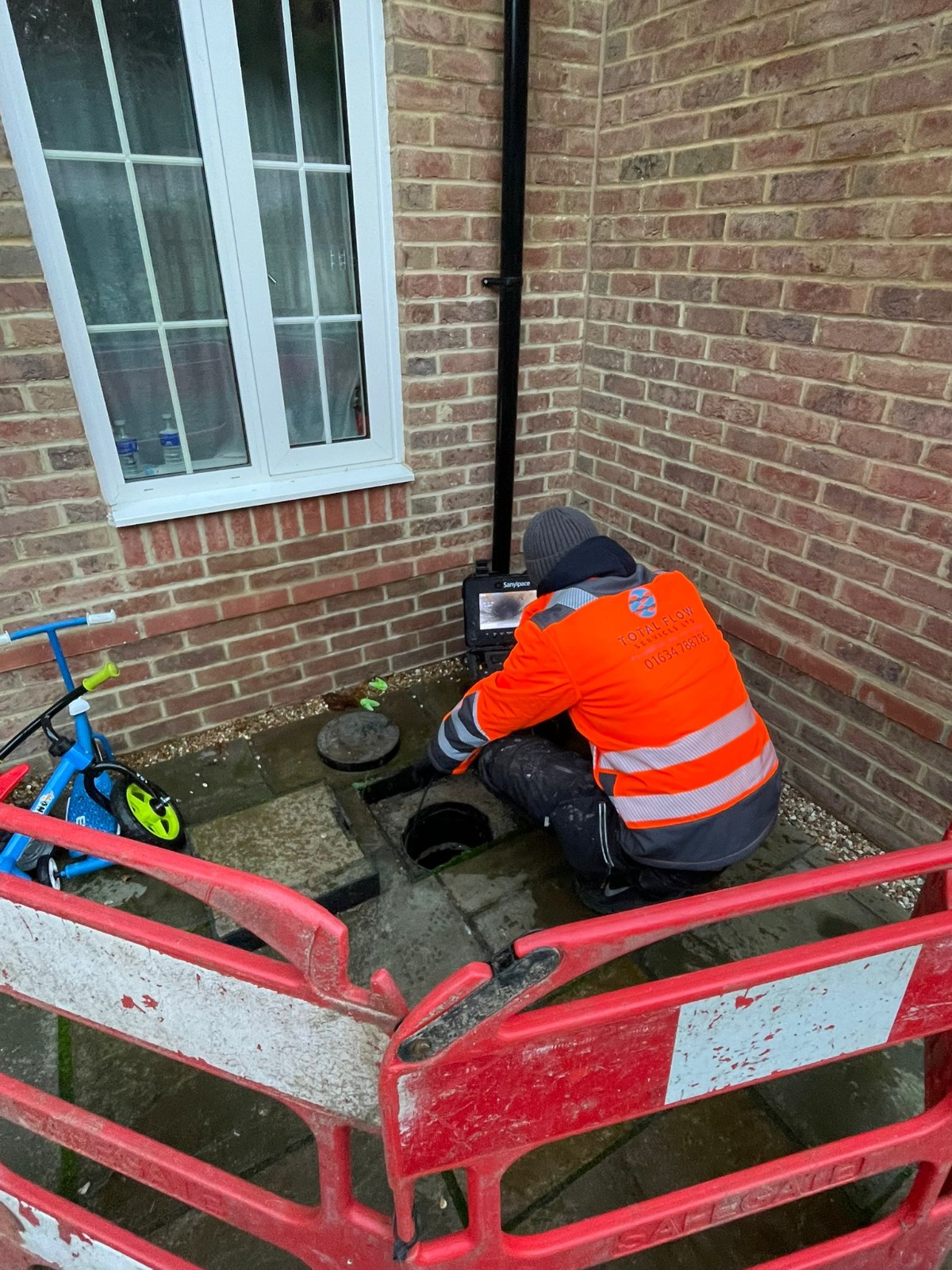
We install patch liners across domestic and commercial drainage in Kent, typically working through a single manhole. Pre and post-cure CCTV passes are included in every job, with footage and written reports for your records.
What happens if you wait
Leaving a known defect alone almost always makes the eventual fix worse
A crack in a clay drain doesn't heal. Roots in a joint widen the joint. A small displaced connection becomes a complete separation. The longer a known defect is left, the bigger the eventual repair — and the more likely it becomes that no-dig stops being an option and excavation becomes inevitable.
Small cracks become full breaks, displaced joints become collapses, root ingress eventually destroys the host pipe entirely.
Leaking drains wash supporting soil away from foundations. Subsidence claims regularly trace back to known and ignored drain defects.
Insurers increasingly require evidence that drainage defects flagged on previous reports were actioned. Inaction can invalidate cover.
Common mistakes we fix every week
- Patch lining a pipe that's too far gone — patches need a structurally sound host.
- Skipping the pre-installation clean — liner won't bond to greasy or root-fouled walls.
- Using the wrong resin for the temperature and cure conditions.
- Installing a patch over a junction without using a junction-specific liner.
- Cutting corners on the post-cure CCTV pass.
- Refusing to patch and pushing excavation when a liner would have worked.
Our process
A predictable, step-by-step system — no surprises, no upsells
-
STEP 01Diagnostic CCTV
Locate the defect precisely, measure its length and confirm patch lining is the right repair.
-
STEP 02Pre-clean
Jet and root-cut the host pipe so the liner has a clean, sound surface to bond to.
-
STEP 03Prepare and position
Saturate the liner with resin, mount on a packer and position over the defect via the manhole.
-
STEP 04Inflate and cure
Inflate the packer to press the liner against the host pipe wall, cure for 60–120 minutes.
-
STEP 05Verify
Post-cure CCTV pass, footage, written report and workmanship guarantee in writing.
What you get
Concrete outcomes — not vague promises
25-year design life on the patch — longer than many host pipes survive uneventfully.
All work done through existing manholes — no driveways, lawns or paths disturbed.
From arrival to driving away is typically 3–5 hours for a standard patch.
Liner thickness is around 3–6mm — no meaningful effect on flow.
Pre and post-cure footage and reports formatted for insurer and solicitor use.
Workmanship guarantee on the installation, plus liner manufacturer warranty.
Technical detail
What separates a good patch liner installation from a failed one
A patch liner is only as good as the pipe it bonds to and the installer who fits it. Skipping the pre-clean, getting the resin temperature wrong, or positioning the patch a few inches off the defect all result in failures that show up on the next CCTV survey.
Picking the right defect for a patch
Patch liners are designed for short, localised defects in otherwise sound pipework — typical examples are a single cracked clay section, a displaced joint, or a small fracture. Fully collapsed pipes, runs with multiple closely spaced defects, or seriously distorted pipework need a different repair (full reline, junction repair or excavation).
Pre-installation pipe preparation
The host pipe must be clean and dry where possible. Roots are cut back, fat and scale are jetted off, and the pipe is dried with a brief blower pass where conditions allow. A liner bonded to a fouled pipe wall is a liner that delaminates within five years.
- High-pressure jetting to clean the pipe wall
- Root cutting to leave a sound surface
- Brief drying pass where access allows
- Final CCTV before liner installation
Resin selection and cure
Resin type — typically silicate, epoxy or polyester — is chosen for the pipe material, water content and ambient temperature. Cure time is monitored on temperature, not just elapsed minutes. Done correctly, the resin is fully cross-linked and the patch is permanent. Done badly, the liner cures soft and fails within months.
Verification and handover
Every patch ends with a post-cure CCTV pass to confirm full bond, correct positioning and a clean internal finish. Footage is saved and a written report issued. This is the document your insurer, solicitor or buyer wants to see — and the proof that the defect is genuinely fixed.
Frequently asked
Straight answers to the questions Kent homeowners ask us most
How much does a drainage patch liner cost?+
Most standard patch liners are fixed-priced per installation including pre and post-cure CCTV. Multiple patches in the same run reduce the per-patch cost significantly.
How long does it last?+
Patch liners have a 25-year design life when correctly installed in a sound host pipe. Many installations comfortably outlast that.
Can any cracked drain be patch-lined?+
Most can. The host pipe needs to retain its overall shape and integrity. Fully collapsed or seriously distorted pipes typically need different repair methods.
Will it reduce the drain's capacity?+
Marginally — typically 3–6mm of internal diameter is lost to the liner thickness. No practical impact on flow.
How do I know the patch is in the right place?+
Both the pre-clean CCTV and the post-cure CCTV are recorded. You see the defect before, the patch in position, and the finished internal surface.
Is it accepted by home insurers?+
Yes — structural patch lining is a recognised industry-standard repair and is accepted by major UK home insurers.
What guarantee do you offer?+
Workmanship is guaranteed for up to 5 years from the date of installation, plus the liner manufacturer's product warranty.
Can you patch on the same day as a CCTV survey?+
Often, yes — if the survey confirms a clear, short defect and we have the right liner specification on the van.
Related services
Areas we cover
Permanent drain repair — without lifting the driveway.
Patch lining quoted from CCTV. Single-visit install. 25-year design life on every patch.
Fully insured · Workmanship guarantee · 7 days a week