Blockage clearance in Kent
Blocked sinks, toilets
and drains — cleared,
diagnosed and signed off
From a slow-draining kitchen sink to a backing-up external manhole, we clear blockages properly — then prove it on camera so the same problem doesn't come back next month.
What it covers
Sink, toilet, gully and main-drain blockages — cleared in one visit where possible
Most blockages are predictable. Wipes in toilets. Hair in shower wastes. Cooking fat in kitchen drains. Leaves and silt in rainwater gullies. Roots growing into joints on Victorian clay drains. Each has a proper way of being cleared — and a proper way of being prevented from recurring.
Our blockage work covers every part of a domestic and commercial waste system: sink and basin wastes, baths and showers, toilets and macerators, kitchen drains, external gullies, rainwater downpipes, soakaways and main foul runs to the public sewer. We arrive with hand tools, electric augers, rods and high-pressure jetters so the right tool is used for the right job.
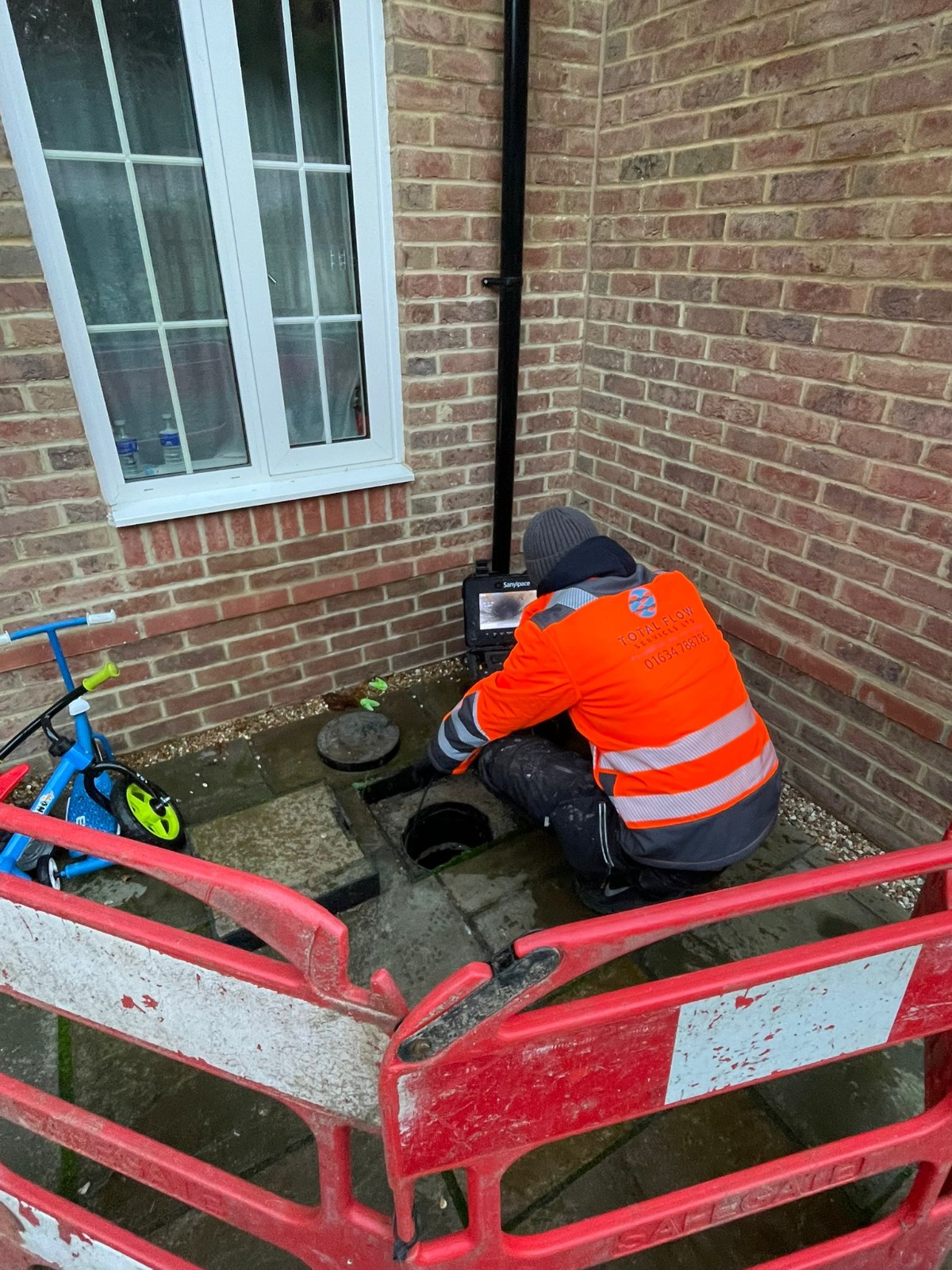
Every clearance ends with verification. For sinks and traps, a flow test. For main drains, a quick CCTV pass to confirm the pipe is fully clear and to identify any underlying defect — roots, cracks, displaced joints — that caused the blockage in the first place. You get the answer in plain English, not vague reassurances.
What happens if you wait
A blockage you keep clearing is a blockage you haven't actually fixed
Repeat blockages are almost never bad luck. They're a symptom — a cracked pipe collecting debris, roots in a joint, a poorly graded run, or fat build-up that hasn't been properly cleaned. Clearing the same drain three times a year costs more than fixing the cause once.
An ignored partial blockage becomes a full backup on the worst possible day — usually Sunday evening, into a bathroom you've just had refitted.
Repeated rodding through a cracked pipe accelerates failure. What was a £400 patch becomes a £4,000 excavation.
Persistent foul-air smells and rodents in the garden are classic signs of a damaged drain run. Insurers and councils take both seriously.
Common mistakes we fix every week
- Pouring caustic chemical unblockers down a pipe that's already cracked.
- Using a garden hose 'jet' attachment that doesn't have the pressure to scour fat.
- Plunging a toilet with a sealed downstream blockage and forcing waste into the floor void.
- Ignoring gurgling sounds — almost always a partial blockage or venting issue.
- Pulling apart a sink trap without a bucket and finishing the job with a bigger leak than blockage.
- Skipping CCTV verification and assuming the drain is fine because the water now flows.
Our process
A predictable, step-by-step system — no surprises, no upsells
-
STEP 01Phone triage
Symptoms, location and access taken on the call so we arrive with the right kit.
-
STEP 02Locate the blockage
Inspect manholes, trace the system and confirm exactly where the problem sits.
-
STEP 03Clear properly
Hand tools for traps, augers for internal lines, jetting for main drains — minimum force, maximum scour.
-
STEP 04CCTV verify
Camera pass on main runs to confirm the pipe is fully clear and identify any underlying defect.
-
STEP 05Report & guarantee
Verbal answer on site, written report on request, workmanship guarantee on the work performed.
What you get
Concrete outcomes — not vague promises
Jetting scours the whole pipe wall — the blockage doesn't simply move two metres down the run.
CCTV verification spots roots, cracks and bellies so a repair can be quoted before it becomes a flood.
Standard domestic unblock is a single set price — no per-hour creep on the invoice.
Sheeting, hand-wash kits, wet vacs and a final wipe-down on every job.
If the blockage was one-off and the pipe is sound, we'll tell you so and not invent repairs.
Workmanship guarantee on the clearance — and on any subsequent repair we carry out.
Technical detail
The right way to clear a blockage — by location and by cause
There's no single 'unblocking' technique. The right approach depends on where the blockage is, what's caused it, and what the pipe is made of. Using the wrong tool either fails to clear the problem or damages the pipe.
Internal waste pipes — traps, basins and sinks
Most kitchen and bathroom blockages sit in the trap or the first metre of waste pipe. Hand removal, careful augering and a flush-through with detergent clear the vast majority. Caustic chemicals are almost never the right answer — they degrade the trap seals and rarely shift a true blockage.
WCs and macerators
Toilet pan blockages clear with a proper plunger or a closet auger; macerator pumps need stripping and rebuilding when they jam. We carry parts for Saniflo and similar systems on the van so most fixes happen on the same visit.
External gullies, manholes and main runs
External blockages need high-pressure water jetting. Our units run at up to 4,000 PSI with heads selected for fat, roots, scale or silt. Jetting clears the full pipe diameter rather than just punching a channel through the blockage, which is why properly jetted drains stay clear far longer than rodded ones.
- Fat and grease clearance with rotating jet heads
- Root cutting on clay and pitch-fibre joints
- Silt and leaf removal in rainwater systems
- Limescale descaling in older cast iron
Why every main-drain clearance includes a camera pass
A clear drain that blocked once will probably block again unless you know why. A 60-second CCTV pass after clearance tells you whether the cause was one-off (a wipe, a child's toy) or structural (a crack, roots, a partial collapse) — and lets us quote a proper fix rather than coming back monthly.
Frequently asked
Straight answers to the questions Kent homeowners ask us most
How much does it cost to clear a blocked drain?+
Our standard domestic unblock is a fixed fee that covers attendance, jetting where required and a CCTV pass on main runs. You'll know the price before we start — no hourly billing.
Do you charge if you can't clear it?+
If we attend and the blockage is genuinely beyond clearance — typically a fully collapsed pipe needing excavation — we charge an attendance fee only, and any clearance fee already taken is credited against the repair quote.
How quickly can you attend a blocked drain?+
Typically 1–4 hours across Kent and Medway for genuine emergencies. Non-urgent jobs are usually booked within 24–48 hours.
Will jetting damage my pipes?+
Not when used correctly. We select pressure and head type for the pipe material and condition. We won't jet a pipe a CCTV survey has shown to be structurally damaged — we'll quote a repair instead.
Can you clear blockages in the public sewer?+
Yes for the lateral connection on your property. If the blockage is in the public sewer (typically beyond the curtilage), we'll identify it and help you raise it with the water authority free of charge.
Why does my drain keep blocking?+
Almost always one of: fat build-up, root ingress, a partial collapse, a poorly graded run, or wipes being flushed. A CCTV pass identifies which — and gives you the chance to fix it properly rather than ringing every six months.
Do you do commercial blockage contracts?+
Yes — planned preventative maintenance for cafés, restaurants, care homes and offices. Typically quarterly visits with jetting and a CCTV pass to keep drains clear and EHO records up to date.
What areas do you cover?+
Kent, Medway, South-East London and the surrounding Home Counties. Same engineers, same vans, same prices — no franchise subcontracting.
Related services
Areas we cover
Blocked? We'll be on-site today.
Tell us what's draining slowly and we'll book you in for a same-day visit where possible. Fixed price quoted on the call.
Fully insured · Workmanship guarantee · 7 days a week